I have been dreaming of visiting Desert X for years, and I finally happened to be in the Coachella Valley area this past March. Desert X is a free, contemporary art exhibit created by artists from all over the world that engage with the desert landscapes in the Coachella Valley area. The exhibit runs from March 8th until May 11th, so make sure to get there within the next month if you would like to experience this desert-inspired art.
Visit the Desert X website to read artist statements and find the coordinates for each piece. There are 11 installations this year, and I was able to visit seven of them during my day in Coachella Valley.


The first installation I visited was “G.H.O.S.T Ride,” by Cannupa Hanska Luger, which is located in Desert Hot Springs. To visit his piece, I hiked 0.7 miles through the beautiful, desert landscape to find it. The short hike is worth it though, because it’s memorizing to see this chrome vehicle out in the middle of nowhere. Luger is indigenous to the Standing Rock Reservation and uses his knowledge of Indigenous technology when creating this piece, which envisions sustainable-land based futures along with other pieces in his Future Ancestral Technologies (FAT) series.
In Luger’s artist statement, he says, “I want the audience to consider themselves ghosts moving through the landscape for the people who are inhabiting this vehicle. They are the ancestors of these folks who developed and sustained a relationship with the land that was generative and passive and still didn’t lose style.” I did, in fact, feel like a ghost while visiting this futuristic art carefully placed in a landscape that is highly susceptible to climate change.
“Once we recognize we can look at the land with reverence rather than resource, we began to understand not the value of being here, but the cost,” say Luger.

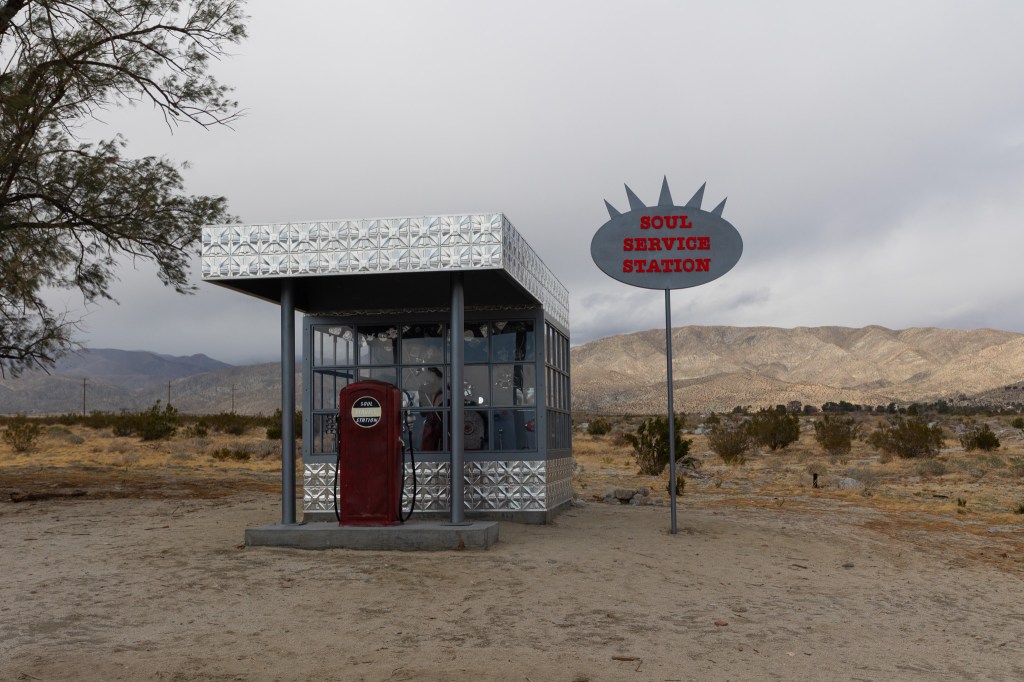

I then drove a few minutes to visit “Soul Service Station” by Alison Saar, which is a gas station designed to help your spirit. This piece was was quite crowded and just a short walk from the road. There were signs leading up to the station that said something like, “When you can’t see ahead, we wipe your windshield clean and clear. When your heart has fallen flat, we pump it up.”
Once you get to the station there is a gas pump equipped with two conch shell-shaped phones that you can put up to your ear to listen to a poem written for Soul Service Station by Harryette Mullen. Inside the station is an employee named Ruby who is made from found materials. Saar emphasizes the process of salvage in her work and uses things like tin ceiling tiles, weathered wood, glass bottles, and cast-iron pans to make this piece.
“When you think about the desert being this landscape for opening your mind and letting go of all of those pressures, it just feels like a collaboration with the landscape in and of itself,” says Saar. Her piece, “provides fuel for the soul,” much like this desert does for many travelers who have visited.
I have always found the Colorado and Mojave deserts to be incredibly healing from past traumas, and I love that Saar took this concept and made a physical station to mend the soul and move forward with healing energy.


Next I visited “The act of being together,” by Jose Davila. This piece is made from marble blocks brought from the US-Mexico border, and looks breathtaking against all the wind turbines. It almost looks natural in this landscape, but there’s something so awe-striking to see these stones stacked on top of each other out here. For Davila’s timeless piece to happen, these stones had to cross the border where they, “traversed a metaphorical border between the seen and the unseen.”
This piece is right off the road after exiting the highway when driving from Los Angeles. I saw them the day before wondering what these stones were and how they got here. In Davila’s artist statement he says the, “casually stacked marble blocks appear splintered across both time as well as space.” Walking among these towering blocks feels eerie because it feels as if time has stood still and meters between the past and future.
“As a child I would somehow give life to the desert through the kid imagination. It’s a landscape that makes you wonder,” says Davila.


Then I drove a bit more into Palm Springs to see “Unsui (Mirror)” by Sanford Biggers, which is next to a park at the James O. Jessie Desert Highland Unity Center. I could have watched these 30 feet tall, sequin-made clouds flicker in the sunlight with the clouds moving quickly behind them forever. I had perfect weather for this piece with the sun reflecting off the mirrors and the clouds moving quickly in the strong wind.
Biggers first started making graffiti clouds when growing up in Los Angeles. He later moved to Japan where he explored “metaphors of meditation and things in nature that are inspirations for that type of lifestyle.” This allowed him to “revisit the cloud in a different light,” later in his life. This piece is made to, “remind viewers of the sort of limitless possibilities and freedom of being a cloud,” which, once again, reminds me of how limitless and free I feel when exploring this desert.
Biggers hopes to, “evoke a feeling of timelessness and transcendence” while his piece shimmers in the desert sun. As the sequins move with the wind and sun, they symbolize change and continuity while also conveying a message of hope and freedom.
“This historic Black community was established in the 1960s after the forced displacement of residents of color from Section 14, a square mile of land near downtown Palm Springs. Activists whose families reside in Desert Highland Gateway Estates continue toward reparations efforts today,” Biggers says in his artist statement. This dreamy piece, which conveys so many important themes, is definitely one of my favorites from the day.


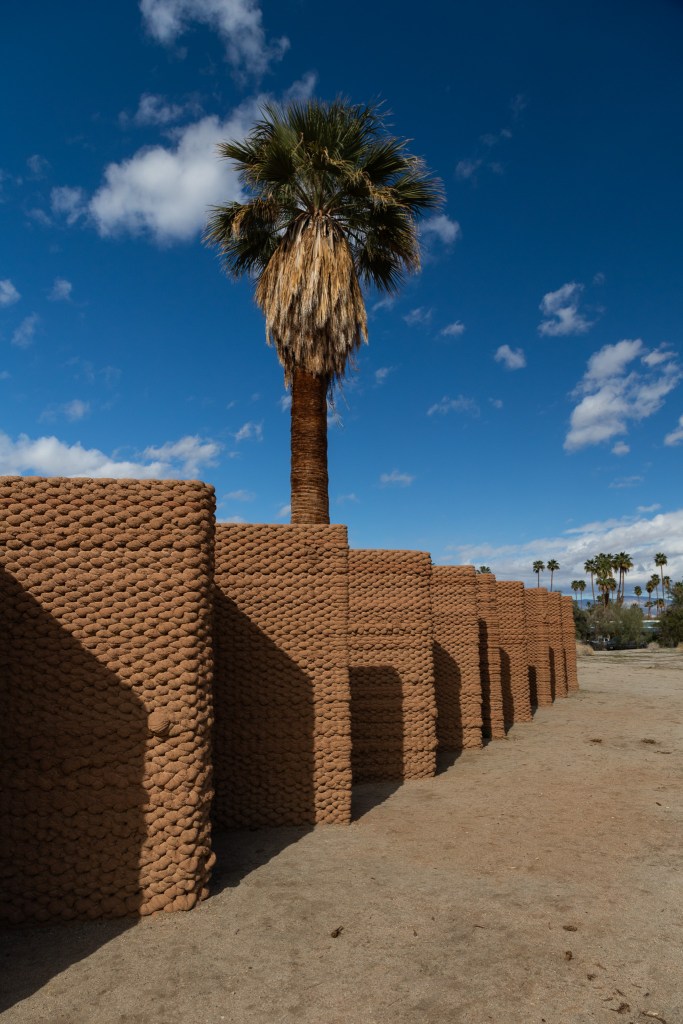
“Adobe Oasis” by Ronald Rael is located near downtown Palm Springs. Rael uses a 3D printing robot to create this intimate piece using adobe. I always appreciate the adobe architecture when visiting the desert, so it was cool to see it utilized for this installation. Exploring and touching this piece felt like a mini maze with a sturdy palm tree sticking out in the center, marking the oasis.
Rael says of adobe, “I love the way it feels, the way it smells, the way the light falls on it, the textures. I want the audience to feel all that, and also to connect between the past and the future.” His piece stands against the backdrop of both commercial and residential buildings in Palm Springs and offers a suggestion to a more sustainable material when developing in the future, “highlighting the potential of earthen materials amid the climate crisis.”
“We naturally have a visceral connection to earth and structures. And we feel them and we understand them, because we evolved to build them,” says Rael.

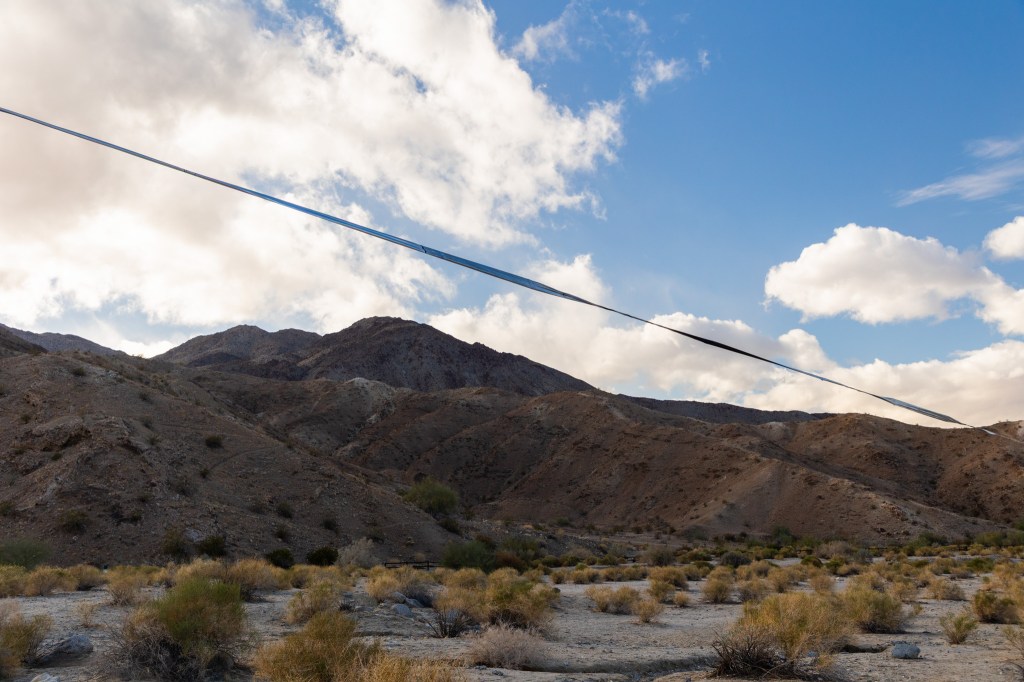
I then drove deeper into Palm Desert to visit “Five things you can’t wear on TV” by Raphael Hefti, a Swiss artist. His piece is inspired by a slackline swaying in the wind to create, “a horizontal flash,” which is something I have noticed when watching a slackline as well.
Hefti uses, “a black woven polymer fiber, originally designed for light but durable fire hoses, coated on one side with a reflective finish,” to create this long horizontal line, which oscillates in the wind.
This piece creates a glitch in the desert heat over the dry mountains to draw, “our attention to the ongoing performance of light and space, expressing the borrowed poetry of a climactic phenomenon.”

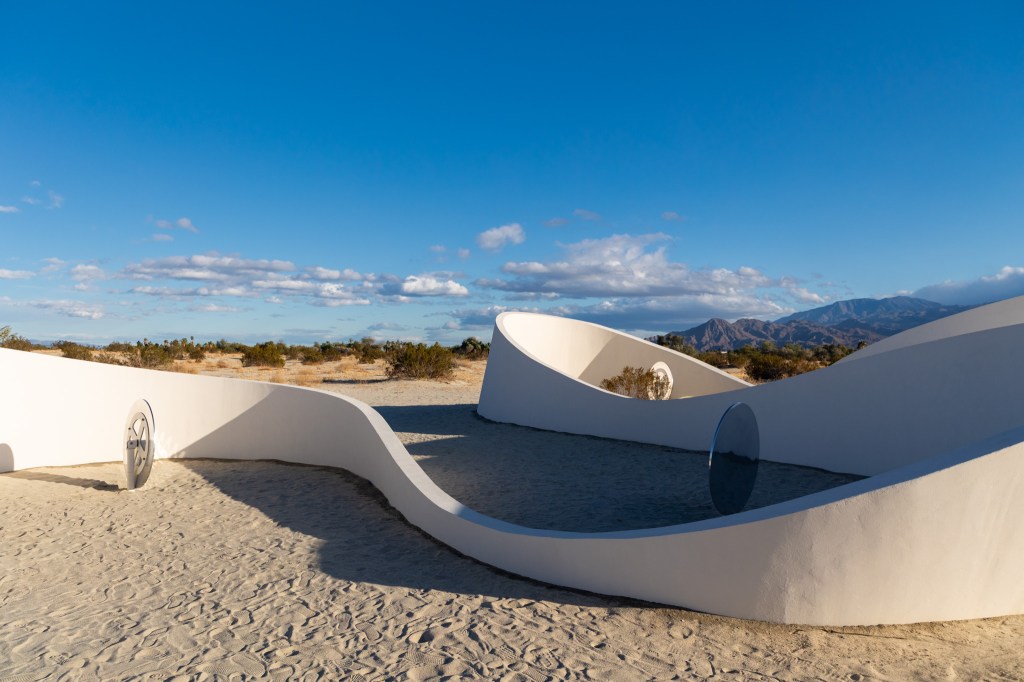


Lastly, I visited “Truth Arrives In Slanted Beams” by Sarah Meyohas. This installation features a curvy, white wall which displays silver plates within each curve. Once again, I was lucky to have a sunny day, because when the sun reflects off these interactive plates they display a message and some other interesting patterns. Meyohas used “ancient timekeeping technology like sundials and pays homage to 20th-century land art,” when creating these plates.
“Truth is definitely something that is at stake in today’s world, and I tried to make art that is not tricking anybody. This isn’t a trick. This is the light, and this is true,” Meyohas says in her artist statement. This piece looked amazing against the purple, desert mountains. This was another installation could have gazed at endlessly.
I was able to visit all seven of these installations in five hours while also stopping for lunch. If you happen to be in the Coachella Valley area before May 11th, make sure to check out some the amazing installations while they are still on display!
 RILEY J ROAMS
Leave a comment